| 
Title: Capacities: Life In The Emergent City. Made in 2010.
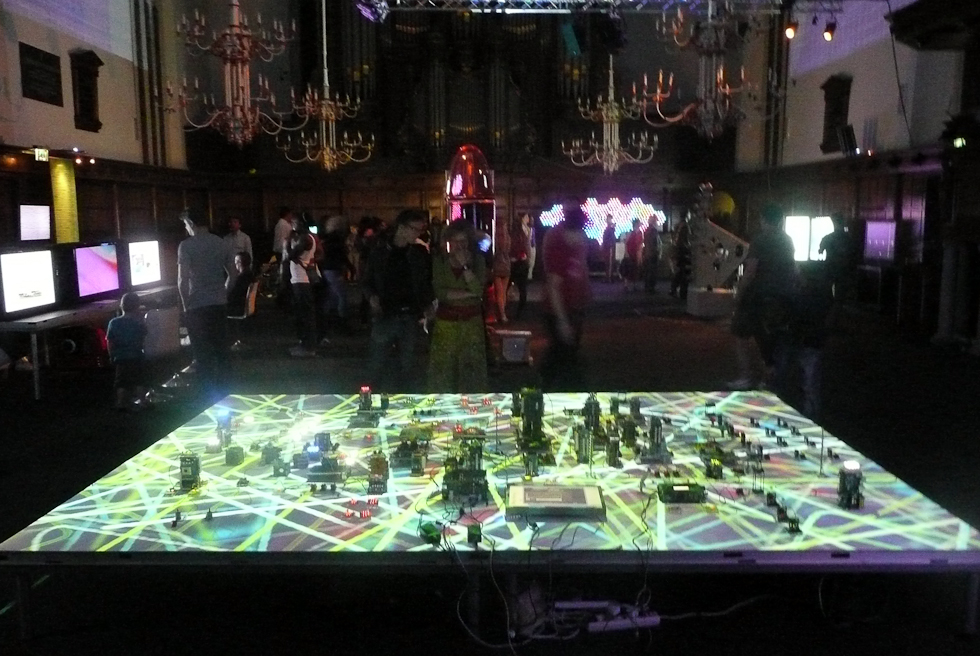
This digital artwork explores new ways of thinking about life, emergence and interaction within the wider city space using real time data to perform the actions you see inside the installation.
About
"Capacities Life In The Emergent City" captures the changes over time in the environment (city) and represents the changing life and complexity of space as an emergent artwork. Capacities goes beyond simple single user interaction to monitor and survey in real time the whole city and entirely represent the complexities of the real time city as a shifting morphing and complex system. What you see is a sculpture which represents the emergent properties of the environment where the sensor network is situated.
In The Gallery.
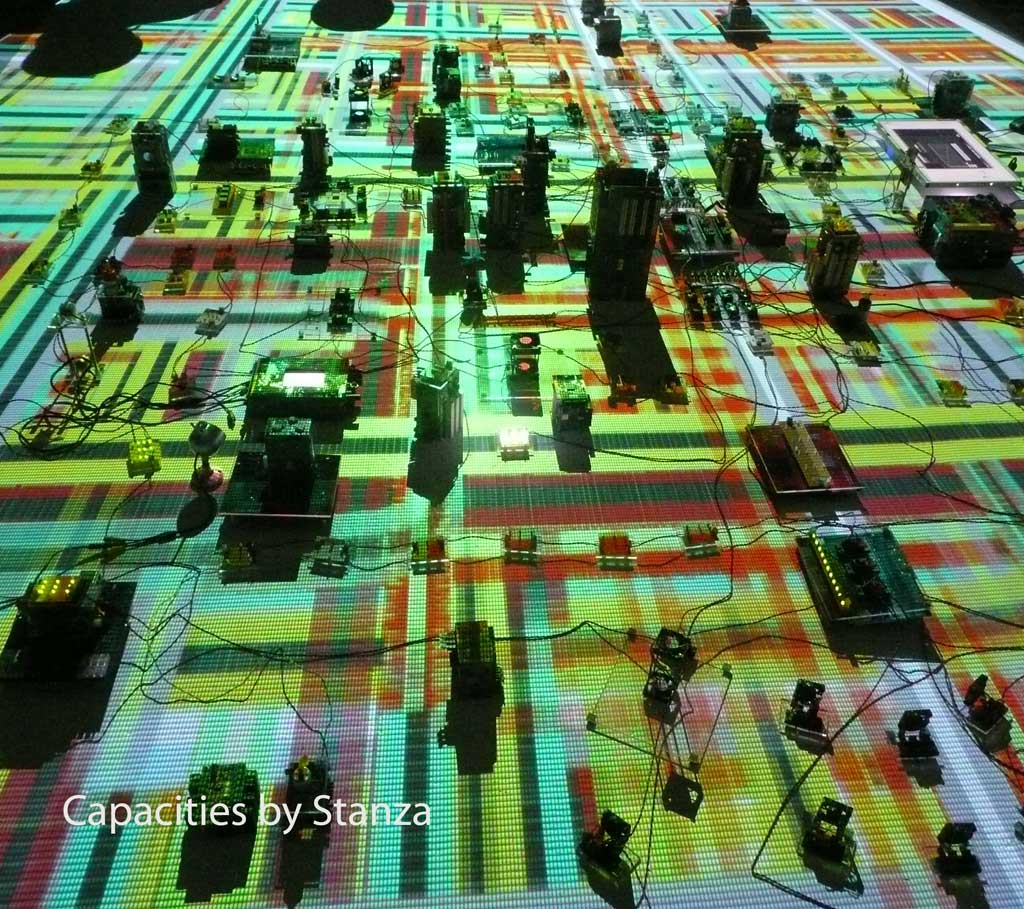
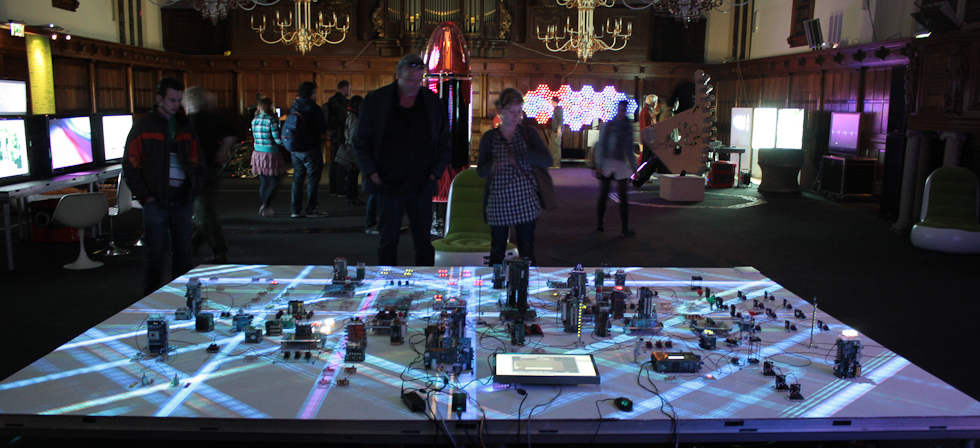
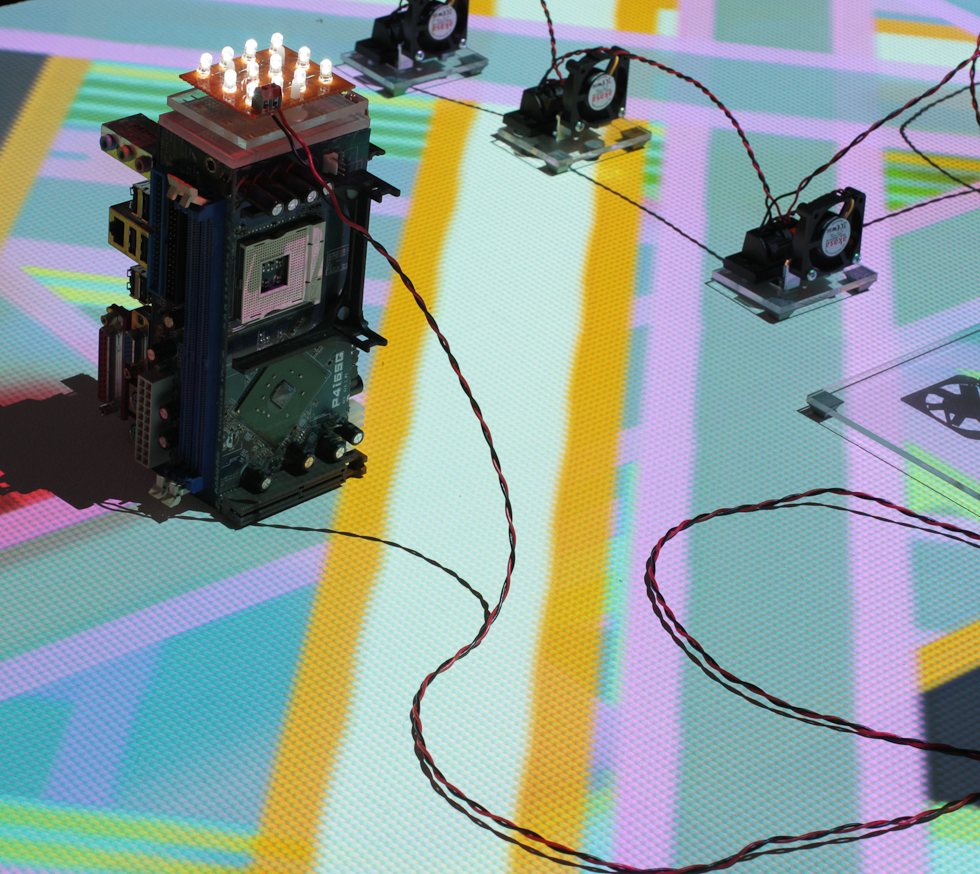
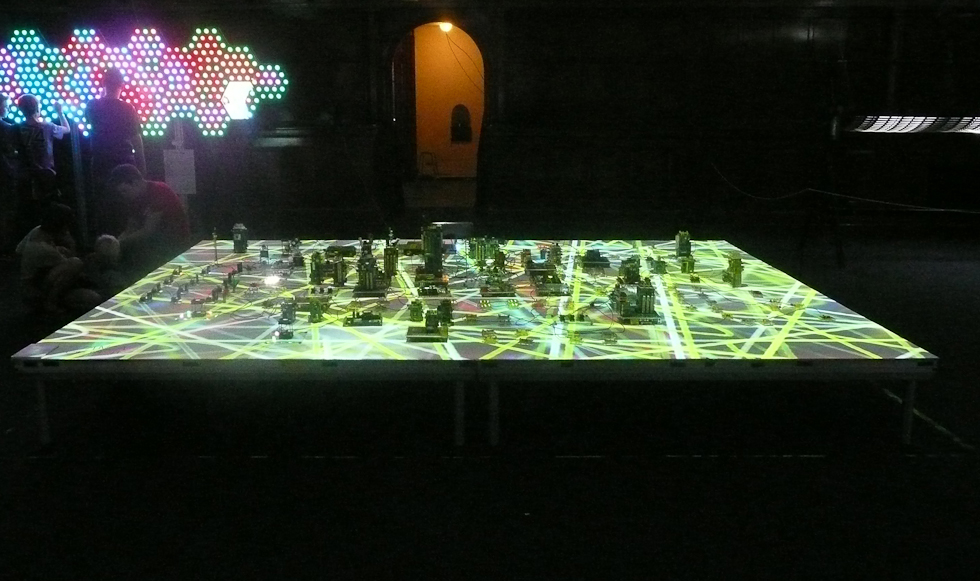
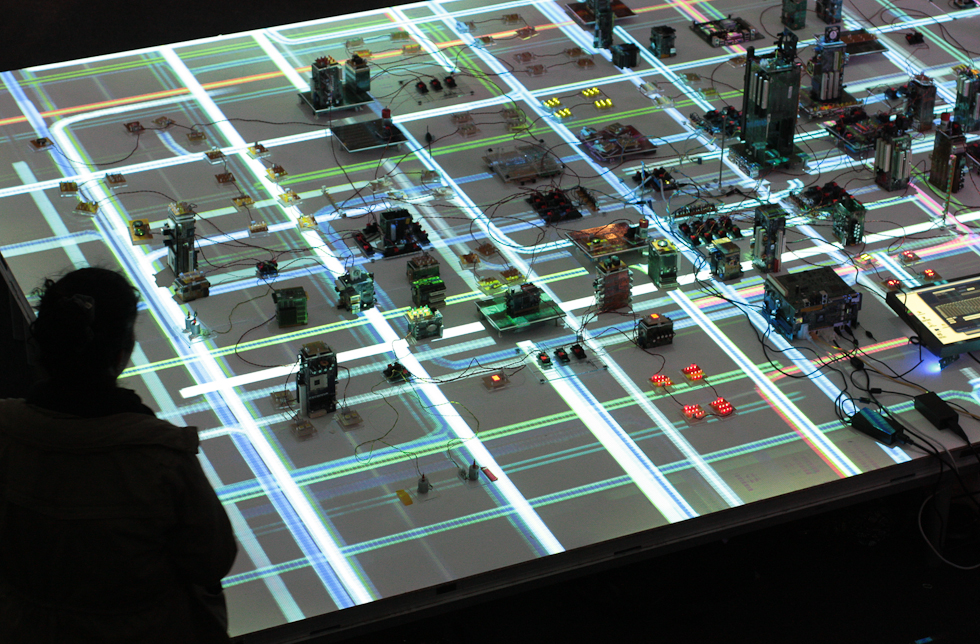
The gallery space becomes a live emergent sculpture to wander through. The changing life in the real time city creates all the changes one experiences in the gallery space. The leads, the wires,and cables are incorporated into the artwork to look like a city map.' Capacities' looks "designed" like a piece of urban design, a city surveyed and controlled. The whole gallery space becomes one large artwork made from real time city information and data. The moving objects, fans, changing lights, motors, noises, that you encounter in the gallery are all responding to changes in temperature, light, pressure, noise, and the sound of the city outside. The aesthetic and feel of the space looks like an electronic city. The city is made of units, grids, repetition, building blocks.
In The City.
The sensor network is laid out across the city (or gallery) to collect the data ie temperature, light, pressure, noise, and the sound of the city (or gallery) .
Concepts.
The artwork is a responsive installation with embedded interactive elements. It is responsive to the live environment via sensors and interactive with its embedded CCTV systems. The artwork gathers data from the city (environment) via a custom made wireless sensor network. This is then represented virtually and then this virtual city is represented as this artwork installation. The work becomes a manipulation of data, that ‘powers’ all the ‘events’ 'actions' and 'processes' in the installation. This project leverages the real time space using data gathered using new sensor technologies and connecting spacesThe project uses environmental monitoring technologies and security based technologies, to question audiences experiences of real time events and create visualizations of life as it unfolds.
Exhibitions
New Technological Art Award Ghent. Belgium 2012
Share Festival Torino Italy. 2012
Gogbot Festival Enshcede Holland. 2011
Lanternhouse. UK. 2010
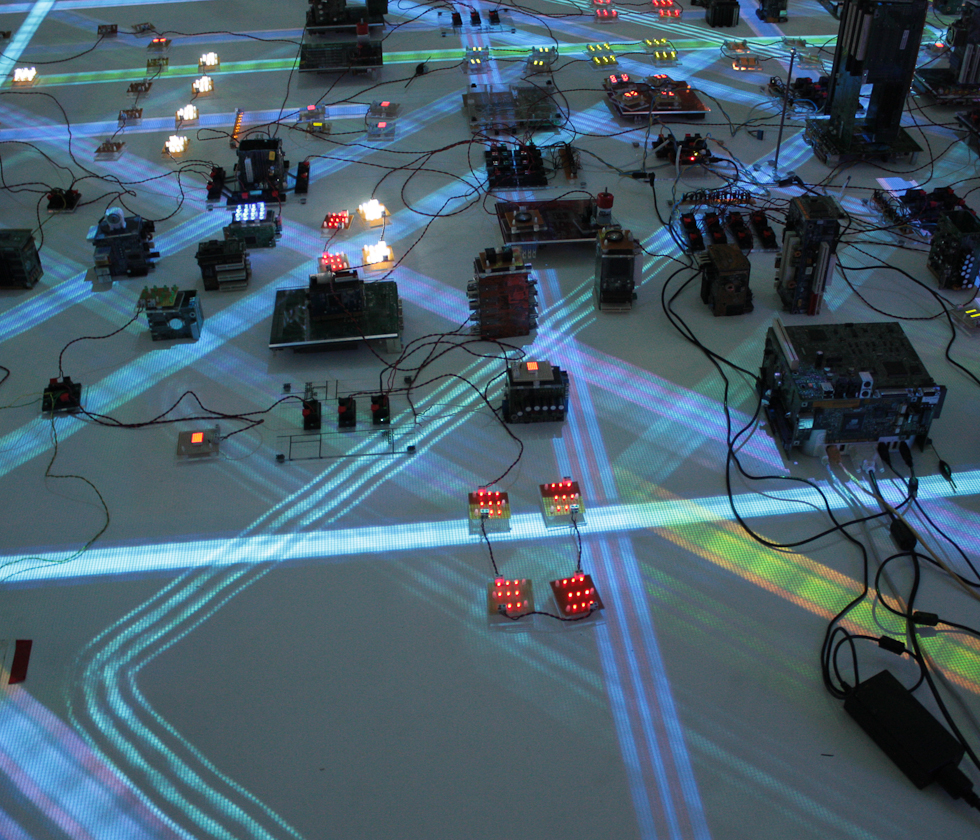
We understand the 20th century in terms of atoms, molecules and gases that move. Our world is now a world of numbers and changing data and information. This art installation manipulates these numbers and the data from the living real world; all of this affects the installation ie the artwork in the gallery space and all the changes occur in real time. The real world is made virtual and the virtual is made real again and exposed in the process. This whole piece is a living and breathing artwork. The project focuses on the micro-incidents of change, the vibrations and sounds of the environment using wireless sensor based technologies.
VIDEO EXPLANATION OF THE ARTWORK (ABOVE)
 Technology Technology
I have been researching wireless sensor networks since 2004 for this project. I have developed the software and I can place sensor hardware to make these installations. This is the physical entity that one can see and hear to experience the real time and passage of time.
I use 40 motes sensors in a network and I have custom built software that gathers data and places the data online via a java proxy server. This then allows me to make artworks with the data. The data include GPS positions, humidity, noise, temperature, light, of the space and the surrounding environment. The interactions of all this data, controlled via interfaces that can re-form and re-contextualise experiences in real time. Representations of these data sets allow unique understanding of the gallery and the urban environment in real time.
The data is also used to create the visualizations in an open source environment. Because the data is networked other online users can also re- interpret the data and interrogate the various sensors in the network as this is open source as well (via xml streams online). The sensor network takes a constant stream of data which is published onto an online environment where each different interface makes representations of the XML and this is used to make an offline and one line artwork. I have tested the sensors, I have written custom software and the main boards are built. The sensors monitor temperature, sounds, noise, light, vibration, humidity, and GPS.
How it Works.
I have 40 motes multi sensor network that are scattered thought the the building and across the city or location space. The nodes can be placed up to 50 -300 meters apart over the space. I am an expert in wireless sensor technologies as a result of my AHRC creative fellowship. Once switched on they gather the data. I have made two versions of the interface software and custom built software for real time data over networks. Mote proxy is a java middle-ware environment for connecting up xbow motes to get access to the data outside moteview and directly off the motes. It is now in version two and sits on our servers. It allows access to two networks of twenty motes in real time from which php and xml pages are served up. Mote proxy version two, and allows real time polling of data online from any sensors network that is connected and switched on, the data is then formatting in PHP and XML to enable anyone to make a visualization or interpretation of the data with it. The changing data is what affects what you see and experience. Live XML feeds form real time sensors when switched on. The sensors monitor temperature, sounds, noise, light, vibration, humidity, and gps.
Hardware Parts: List of Parts used
For floor piece Computer CPU cables, monitor, LED 7x5 matrix, PCB stand-off, Red square LED display, Yell rect LED display, White 3mm 12v LED Red 3mm 12v LE, Green 3mm 12v LED, Angle brackets, terminal block 2pin, soft feet, 7 seg display 0.52 red cath, 7 seg display 0.52 red anode, White Veroboard, Plain Veroboard, clip motors, pull solenoid green 7x5 matrix, green rect LED, Akasa 60mm fan , Akasa 30mm fan , Motor 3v, Motor 12v with reduction gearbox, 1.5” clear cone speaker, rubber feet, small push solenoid, 3.5mm bolts, 3.5mm nuts 3.5mm crinkle washers, Red 16/02 wire, Black 16/02 wire. Cables.
Hardware for sensor data gathering. Computer, gateway and motes. Inventory for five boxes.
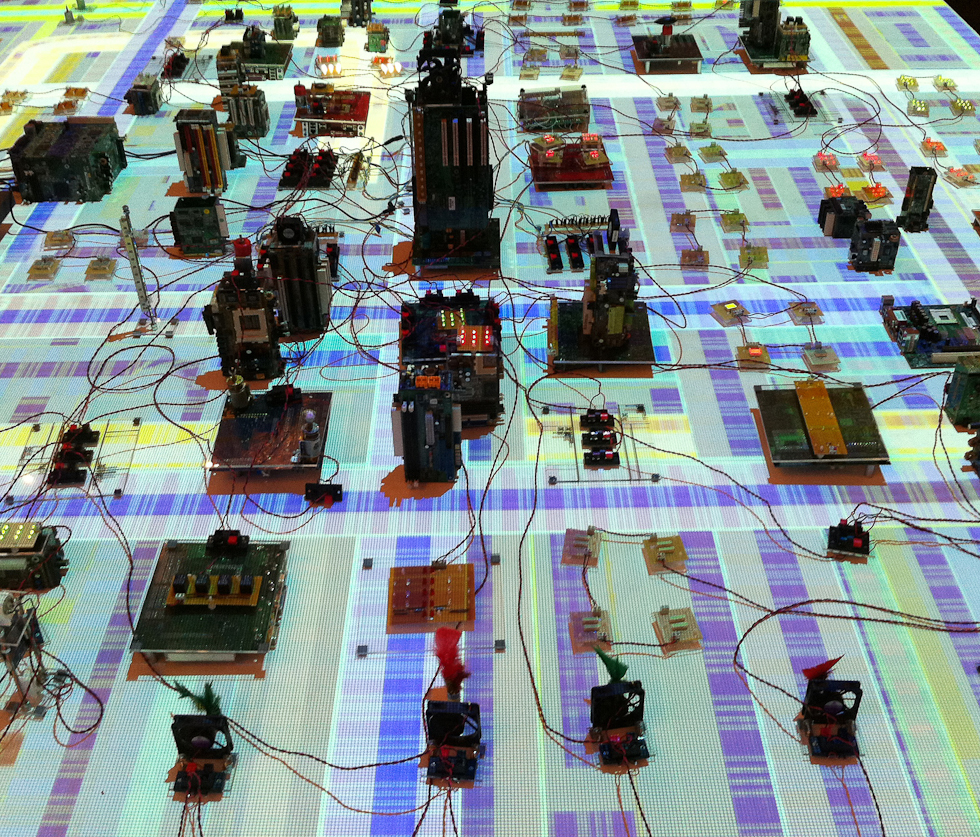
Experience The main artwork appears all over the floor. As you walk in the space the floor is a city of bits. The sensors that are used to display the data are also used and exhibited across the gallery and the city.
News.
Stanza wins SHARE PRIZE 2012 in Torino. The short-list of the Jury reflects the reappearing artistic interpretation of the modern urban landscape as system, where the solid element is replaced by the message, the information and the database, a real, but dematerialized city. Artists have been short-listed by an international jury, consisting of Simona Lodi, Carlo Ratti, Bruce Sterling and Mirjam Struppek, on the basis of the artistic value of their work and its relevance to the Share Prize theme. Le parole OPEN YOUR CITY sono la traccia tematica che ha guidato la mostra di Share Prize. Il premio ha come obiettivo scoprire, promuovere e sostenere le arti in epoca digitale. La selezione delle opere finaliste della mostra è dedicata agli artisti che interpretano l'innovazione come linguaggio di espressione artistica, in ogni modo e forma. Una giuria internazionale composta da Simona Lodi, Carlo Ratti, Bruce Sterling e Mirjam Struppek hanno scelto gli artisti in base all'aderenza al tema e al valore estetico dell'opera. Capacities: Real Time Complex – Connected Cities dell'artista inglese Stanza dedica la sua installazione alla complessità della vita in determinato ambiente. Ogni ambiente è sottoposto a cambiamenti continui che sono monitorati in tempo reale. I cambiamenti portano continua tensione e stressano il concetto di linearità ed evidenziano le emergenze che compaiono. In questo caso l'organismo è la città e non il singolo cittadino ma l'intero complesso urbano, tracciandone il profilo come sistema multiforme. L'installazione è lo specchio in real-time di ciò che si modifica, raccogliendo grosse quantità di dati trasformati esteticamente in una copia della città ma fatta di cavi, luci e sensori che esprimono il passaggio degli elementi ambientali raccolti in forma numerica. L'attenzione insistente è osservare i dati ambientali raccogliendo la temperatura, la luce, la pressione atmosferica, il rumore, e il suono della città fuori dal museo. Raccogliere elementi numerici che riguardano l'ambiente è diventata un'arte e l'arte e' diventata un insieme di dati piuttosto che un insieme di molecole.
Exhibition. Booking.
This works is available for exhibition and touring.
I prefer it to be set up on a plynth. This needs to be strong enough to stand on and painted with good vinyl silk white paint.
Projector needs to be above the work. The projector needs to be mounted above the work before I can begin set up. A dark room is best.
An artist artwork fee, insurance, set up labour time, transport of work, travel, accommodation and all expenses, etc must be covered. email: stanza at sublime.net 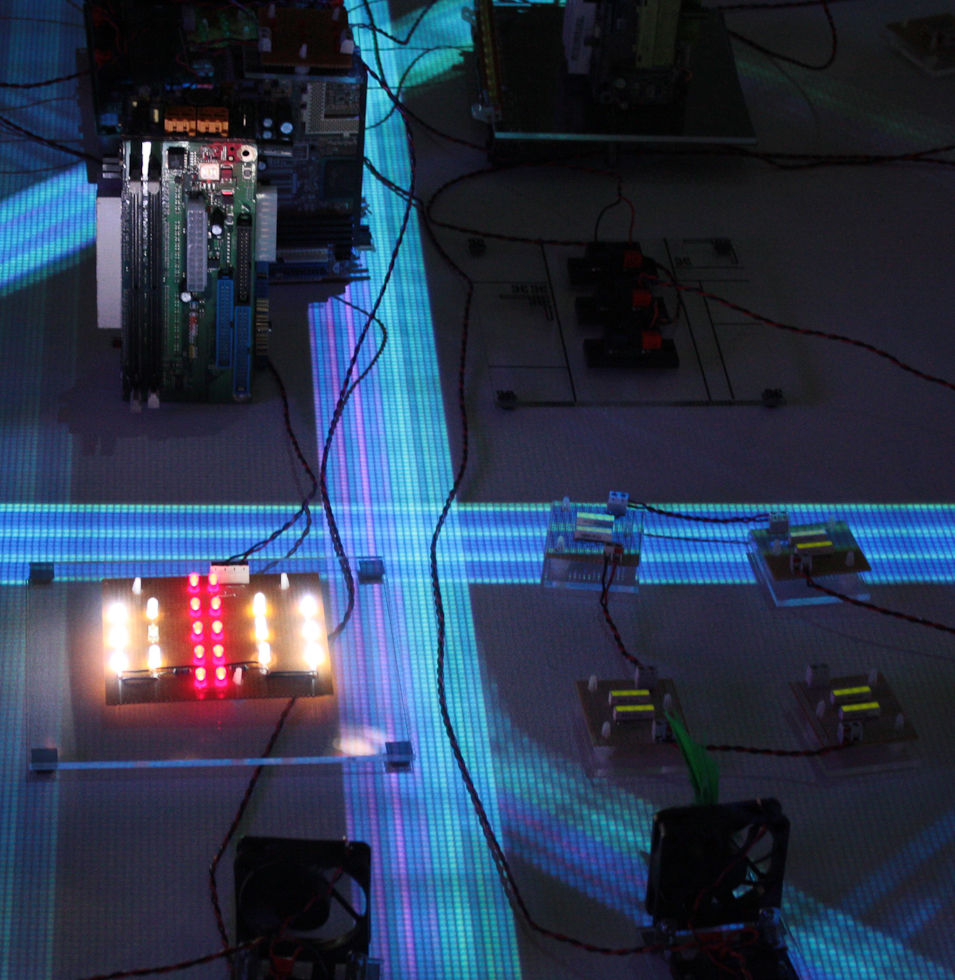
TEXT
From the essay "In Search of a Digital Masterpiece (or Two): Stanza " By Maria Chatzichristodoulou [aka Maria X]
Stanza's current works go further towards inviting the city and the people that inhabit it to populate and become the artwork. From generative and interactive art such as the Central City , Stanza has moved to open systems that collect and re-appropriate real-time data to create multifaceted ‘urban tapestries' (Stanza, 2011), such as the Urban Generation . The even more recent installation Capacities consists of two elements: a physical installation within the gallery space made from hundreds of electronic components such as fans, leads and motors, which resembles a miniature electronic city; and a tailor-made network of wireless sensors that is embedded within the gallery space and the urban landscape that surrounds it, and which collects data from its environment. The data collected ‘include GPS positions, humidity, noise, temperature, and light' (Stanza, 2008). The data and their interactions – that is, the events occurring in the environment that surrounds and envelops the installation – are then translated into the force that brings the electronic city to life by causing movement and change – that is, new events and actions – to occur. In this way the city performs itself in real time through its physical avatar or electronic double: the city performs itself through an-other city. Cause and effect become apparent in a discreet, intuitive manner, when certain events that occur in the real city cause certain other events to occur in its completely different, but seamlessly incorporated, double. The avatar city is not only controlled by the real city in terms of its function and operation, but also utterly dependent upon it for its existence. The co-dependent system of Capacities poses questions around issues of interaction, dependence and control within the hyper-mediatised, surveyed, urban environments that envelop the biological, co-dependent systems that human bodies also are.
Budget and funding.
Funding to make a larger version V2 of the prototype boards and all the components and test has been given by Lanternhouse International. Capacities was the next outcome of my research in the area of data visualisation and feels an important part of my practice as an artist. Many thanks to Lanternhouse International.
Note. Version 3 is available for funding.
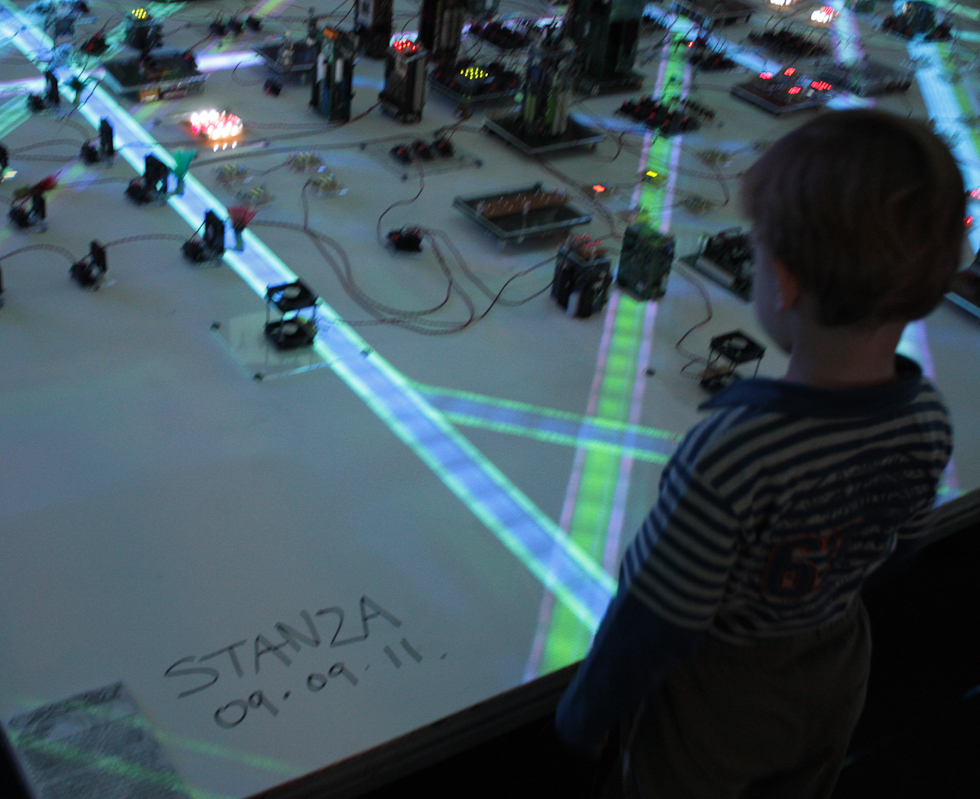
Photos of Installation. Capacities V2 consists of thousands of parts.
Artistic Statement.
I am researching data within cities and the built environment and how this can be represented, visualized and interpreted. Data from security tracking, traffic, and environmental monitoring can all be interpreted as a medium to make artworks. I am investigating new ways of comparing, conceptualizing and then visualizing complex concepts related to the relationship of emergent data and real space in the built environment. Through practice based research, a series of modular experimental artworks are being created to express the possibilities for our data-mediated future.
There are three strands of my working process; these involve collecting the data, visualizing the data, and then displaying the data. The outputs from the online interfaces and online visualizations are now realized as real time dynamic artworks as diverse as installations, and real objects, made out of new display materials back in physical space. In all my work I try to exploit the changing dynamics of city life as a source for creativity and create meaningful artistic metaphors. I utilize new technologies and integrate new media artworks into the public domain as part of this ongoing research into the visualization of city space. In essence I am researching data as a medium for creativity and how meaningful experiences of our cities may result.
By investigating these data structures I aim to create new metaphors relevant to the experience of the environment. The patterns we make, the visual and imaginative interpretations we give to real world events, are already being networked into retrievable data structures that can be re-imagined and source for information. These patterns disclose new ways of seeing the world. The value of gathering and re-presenting this data in artistic form, and then analyzing its impact and influence, lies in making meaning accessible to a wider audience.

Inventory for five boxes.
KEYWORDS. Networked, real time, responsive, life, emergence, mediated, online, connected, dataspace, city, artwork, installation. CCTV.
|