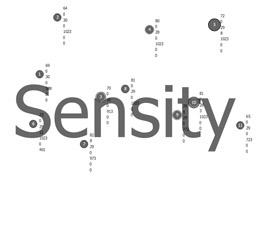
Here is a video (134mb) of me talking about Sensity.
Note: Do not post on you tube, and do not show to a class or public audience or any audience without permission.
------------------------------------------------------------------------------------------------------------
Transcript of the above video on Sensity.
------------------------------------------------------------------------------------------------------------
Hi, my name is Stanza.
I am the AHRC fellow (Arts and Humanties research Fellow) at Goldsmiths College. I have a project called “The Emergent City”, analyzing data from within city space, using various technologies; including wireless sensor motes and CCTV to make artworks. Under this umbrella title there is a number of artworks, “Sensity”, “House” and “Gallery”. All of these artworks have one thing in common, they use wireless sensors to gather data from across networks and to re-interpret this data into various forms of outputs. As an artist gather assets, data, I make visualizations and I think of ways to display the results. This presentation will focus on the artwork Sensity.
As you know a city is a web of connected networks. In essence, the city fabric is a giant multi-user, multi-data sphere.
The city is made up of traffic patterns, pedestrian patterns, bird flocking patterns. Patterns can be seen in the architecture, patterns in the buildings; closer inside the micro patterns of the city, we have the life cycles of the atomised.
All of these spheres can be represented by media and therefore by data within the digital realm. And all of this data can be interpreted and mediated. It becomes a matter of choice.
Cities offer the opportunity for unique types of data gathering experiences via a variety of sources. My objective is to 'mediate' data into conceptual artifacts. With this perspective there are many unimagined threads of data and connections that describe our world that can be explored through wireless mobile networks within which we can create artistic interpretations.
Sensity artworks are made from the data that is collected across the urban and environment infrastructure. I have a network of sensors which collects data, which is then published online. The sensors interpret the micro-data of the interactive city. The output from the sensors displays the "emotional" state of the city online. This information can also be used to create installations and sculptural artifacts.
These artworks represent the movement of people, pollution in the air, the vibrations and sounds of the city. The sensor network can be moved from urban to rural setting and different types of visualization can be made depending on the environment.
So far Sensity has been presented in Paris, Copehagen, Sao Paulo, and I have made several versions in London.
Sensity is also a highly technical project that will give vast amounts of information about the fabric of our cities. By embedding the sensors like this we can re-engage with the urban fabric and enable new artistic metaphors within city space. The sensors are positioned across the city. Custom made software enables these sensors to communicate will one another in a network over a proxy server in real time.
The interfaces online are all real time interpretations of city spaces, in the case (on screen image) Sao Paulo.
The data can also be used to create visualizations in an open source environment. The data is placed online via a mote proxy server that’s been custom written and other academics, researchers and artists can link in to this data to make their own artworks and interfaces.
Temperature information light information, sound and noise sensors create this data that is re worked to create various outputs. Here is an example of Sensity on a 3d display globe.
I have two separate sensor kits both use motes. The motes are used to collect the data, this is an image of one, on the screen. The motes are tiny wireless sensor both that gather the data and communicate with a central server.
The real world is monitored and surveyed and the data is stored in my archive retrieval system. Motes and sensor boards sense the micro incidents of change for example in the weather, noise and traffic patterns. In this case they are measuring temperature, light, humidity, sounds, and my other sensors network has GPS attached.
So we need to imagine the city at a different scale. The possibility is to extend our imagination and enable that perception of the city as a dynamic network. I am putting systems in place that can re–employ our perception and thus create new understanding of how this behaviour unfolds. There are patterns, they are connected and the systems that evolve, can be simulated and acted upon.
We can influence the process and the systems and we can create variables in the system, that allows bi-products of this system and the resulting information.
I have been to Paris, Sao Paulo, London, and Copenhagen to retrieve these data sets. (On screen) This is an example of a merged future city. The data is the medium. Future cities will be merged real time connected up cities. Sensity connects up networks of real time information flow. The results become mashed- up cities and real time performative city mashings using the xml formatting shown previously.
The shared data space can overlap and there is a new space the space in between that only two nodes share. The aestheticization of the shared city space. In the experiment below (image is on screen) I have merged collected data from various cities.
To recap on the technology: I now have several sensors kits both of them have twenty nodes. Some of the sensors can be placed up to three hundred metres apart across the city. I have also made two versions of the Sensity interface software. One works with recorded data, and this is key, and the other works in real time, which means that the sensors are always switched on and always working through a router.
The changing data affects what you see and experience.
This is another project called “Gallery”, that also uses the technology that I have developed. The gallery is made public using a sensor network. I have use the same technology as before to visualize an art gallery. The gallery laid bare as a work of art. The gallery proposes that the data is art. The art is a real time flow of the things around us that allow our senses to invoke understanding. The gallery space becomes the art, described by the shifts in light, temperature, noises in the space over time. Gallery is also a surveillance system.
I live in South London, this is a real time online visualization of my house; again using wireless motes. Again, it is a real time online interface, connecting my house with the real world. “House” is not a mute memorial to a related past but a live embodiment of change and renewal. House describes the space, a real Victorian terraced house, that the artist lives in. The private interior has been made public as the data unfolds. It describes the inherent properties of the space creating an online artwork. Eventually a network of environments and pods can be connected to show a global space a global world of data. All houses and all cities can be connected in this way
Thanks very much
Stanza
www.stanza.co.uk.