Urban Generation: Trying To Imagine The World From Everyone Else's Perspective, All At Once. 2002 by Stanza.
Urban Generation uses 450 networked surveillance cameras from all over the city and presents them back for you to experience. The artwork considers a world of universal and total observation and surveillance. Imagine walking out the door, and knowing every single action, movement,
sound, micro movement, pulse, and thread of information is being
tracked, monitored, stored, analyzed, interpreted and logged and we are complicity involved.
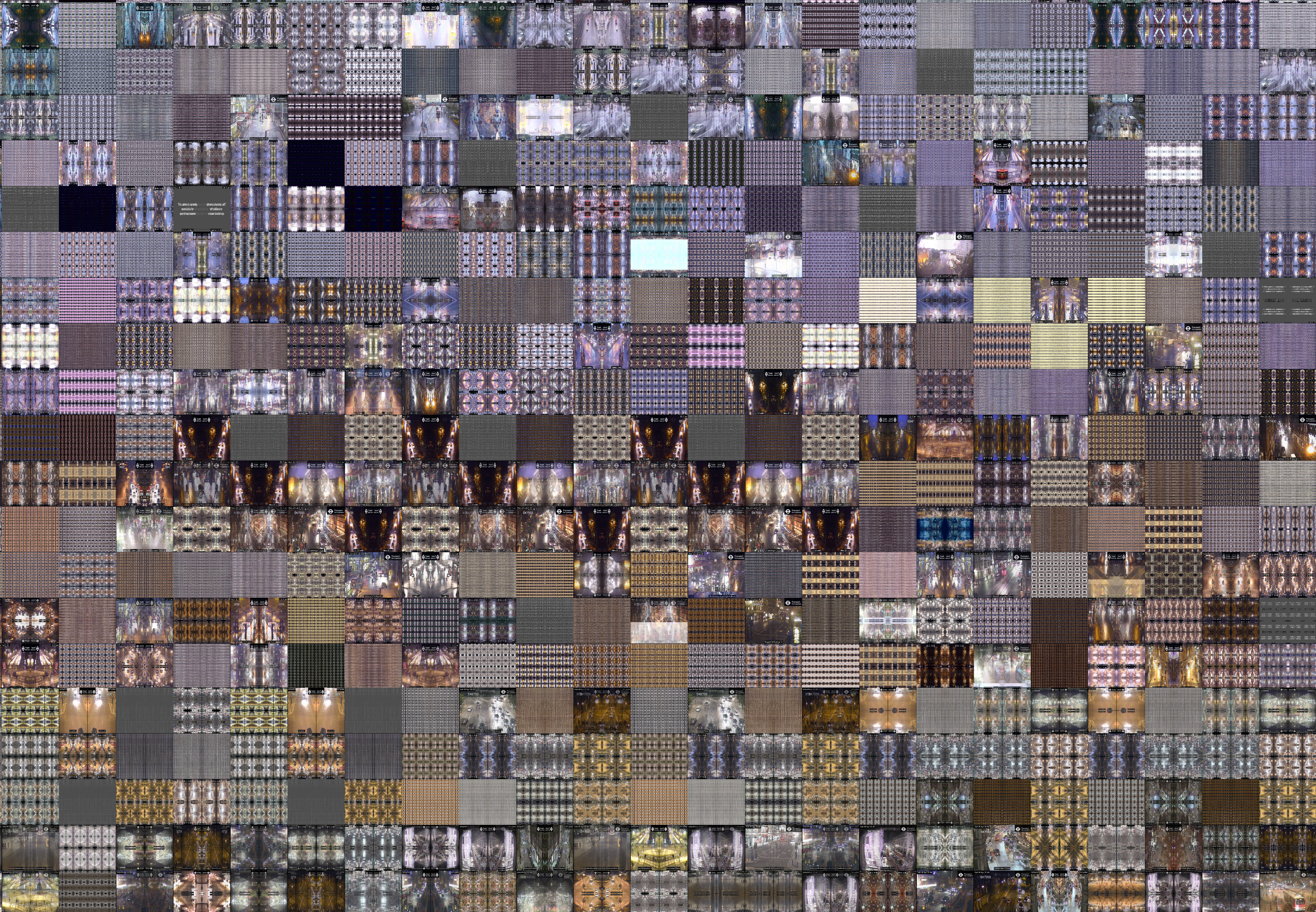
Urban Generation makes visible that which invisibly and silently tracks our movements, habits, and preferences. It forces us to ask ourselves whether pervasive surveillance is inevitable, and whether it is sufficient to allow these billions of hours of stored data to serve as evidence after the fact rather than prevention. The artwork depicts a constant and evolving view of the urban landscape and its inhabitants exploring the controlled state of the metropolis in real time. The observed real time surveillance society is re-worked into a series of grids which is then re controlled by the artists software and presented back online. Here the images are re mediated by the algorithm into what you see its a real time experience of the city from multiple perspectives, a parrallel reality incorporated into what Stanza calls panoptic aesthetics.
The algorithm remediates the connected system of real time data feeds and the arist manipulates this system to create a different narrative. The artwork demonstates how these systems can be reinterpreted to create parrallel realities. We have not walked blindly into the age of universal surveilance we are complicit in the both its design and infrastructure.
To be exhibited as projection based artwork or optionally as an installation. |
Urban Generation: Trying To Imagine The World From Everyone Else's Perspective, All At Once
Touring This work is available for sale and for exhibitions. What can be exhibited is both the screen based online version and the installation version as shown below in the images as well as a number of videos made from the software system.
Availability This work is consists of two parts: the artists software system and computer files as well as the installation hardware display system. Available for collectors including all software set up and hardware. There is also a version with a back up system for provenance that simulates the experience for future proofing.
Funding If you would like to make a massive version using 500 monitors as a giant labyrinth of screens surveilling the whole world as a pixelated panopticon, drop me an email.
Exhibitions of this artwork.
New Art Centre. Spain 2026
Museum Of The Future. Enschede. Netherlands 2022
NMK Dresden. Germany. Curated by Andreas Ullrich 2018
TSSK Trøndelag Centre for Contemporary Art. Metamorf Trondheim. Norway Curated By Espen Gangvik 2014
Watermans Art Centre. London. Curated by Irini Papadimitriou 2014
Alternativa Wyspa Institute of Art / Wyspa Progress Foundation Doki Poland 2013
The Digital Age Durham University. UK2013
Netherlands Media Art Institute - Montevideo/Time Based Arts Amsterdam. Curated by Susanne Jaschko 2009
SXSW Austin Texas USA Plutopia Event 2009. Curated by Derek Woodgate
Aboa Vetus & Ars Nova Itäinen Rantakatu,Turku Finland. Curated by Andy Best. April 2007
Space 4, Peterborough. March 2006
The Brindley Arts Centre, Runcorn. 15th April - 13th May 2006
Shrewsbury Museum and Art Gallery . 9Th June - 9th July 2006
Q Arts, Derby. 12th Nov - 18 Dec 2005
20-21 Visual Arts Centre, Scunthorpe 2005
EMAF Germany 2004
Samsung Media Centre Senef Korea 2004.
Respond by Future Physical. Cambridge UK 2003
The Digital Hub Dublin Ireland 2003
Digifest Toronto Canada 2003
Museo Tamayo Arte Contemporáneo. Mexico. 2002
Net.art in 4L Istanbul. Turkey. 2002
Background Information: 2003
Surveillance systems are everywhere in the public domain. We are all actors, bit part actors, in a giant movie called life. Except we cannot watch, it is not on public display even though the results are monitored, filtered and distributed without our permission.The increase of technology infrastructure in the daily existence of a city means that technology will, more than ever be everywhere in our environment. Everything is or will be tracked. CCTV, tracking via car sensors, tracking inside our phones and tracking our id card movement. The patterns we make, the forces we weave, are all being networked into retrievable data structures that can be re-imagined and sourced for information. These patterns all disclose new ways of seeing the world. The central issue that will develop will be the privilege and access to these data sources. By at least taking some of this data and making something with it one is at least reclaiming ownership of the data and putting it back in the public domain. The value of information will be a new currency as powers change.
The city has millions of CCTV surveillance cameras and embedded surveillance cameras. In essence the city is the biggest TV station and by proxy the biggest surveillance system in existence. Millions of hours worth of data are recorded every day by these cameras on city TV. One can take the sounds and images off live web streams and re-represent them thus creating new interpretations of the city in the process.
So let us imagine a space in which every action, memory, thought, feeling, has a connection to every other action. A space where all data in the system, seemlessly integrates with all others. This place exists, its inside our heads. The emergent metaphor of the brain has many similarities with the emergent connectivity of cities. The city experience is a web of connected networks and multi layered threaded paths that condition us to the emotional state of the city space.
In essence, the city fabric is a giant multi user multi data sphere. To take part you really have to put something back in, that's like life. In this case, to take part you have to input data so others 'may' see the output of the data response.
This scenario leads to identifiction of various type of mobility. Mobility can be seen from traffic patterns, to pedestrian patterns, to bird flocking patterns; to multi-threaded patterns along a time line. Patterns can be seen in the architecture, patterns in the buildings, patterns in the architectural fabric of the urban design network. And closer inside the micro patterns of the city, we have the life cycles of the atomised, the insects, the life of continuity all of which exist along a timeline of past present and future.
The city has a history. Stories relative to time and place, stories from the street. Love stories personal and extreme, crime stories, stories that are small or that can affect global parameters. A possible objective is to 'mediate' data into conceptual artefacts. With this perpsective there are many unimagined threads of data and connections that describe our world that can be explored within which we can create artistic interpretations.
Stanza. 2003.
|
Video Of the software system during London Daytime.
Screen recorded video of the software system made during London daytime.
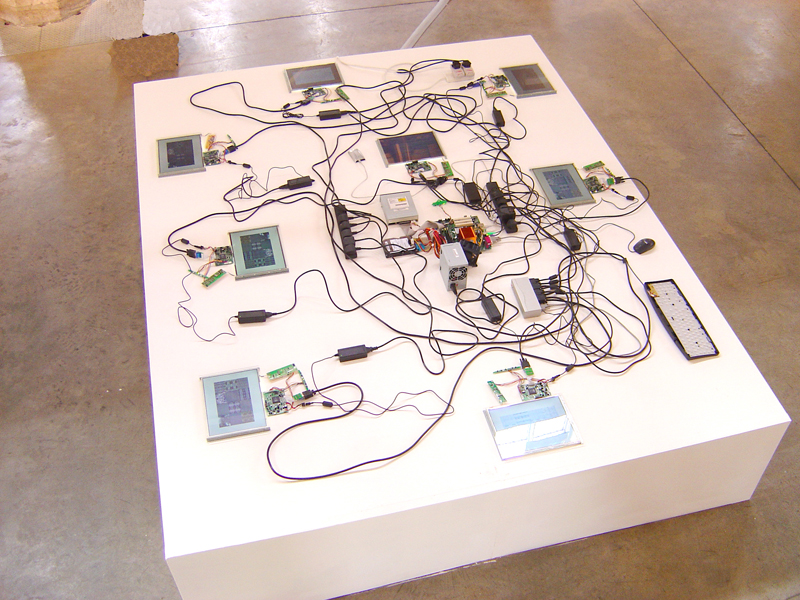
Installation shot Gdansk Poland. Alternativa;2013: Wyspa Institute of Art
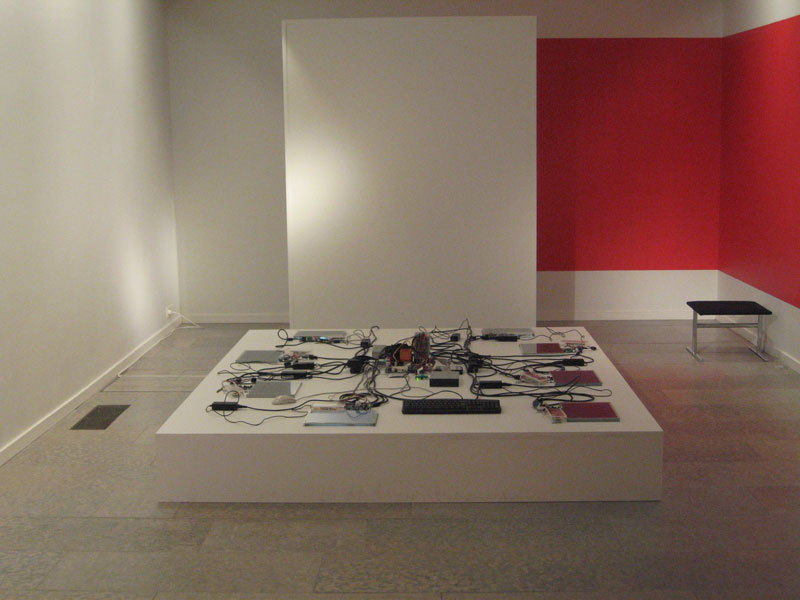
Installation shot taken 2007 in Turku Finland.
Installations shot taken 2007 in Finland.
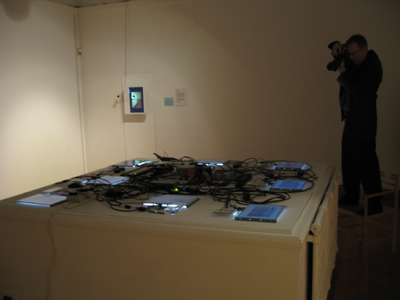 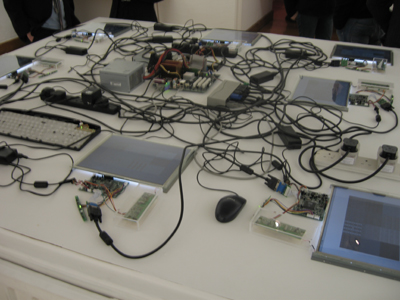
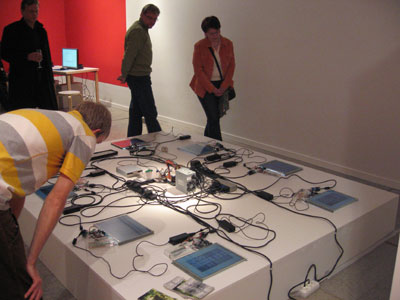
Installation shots. Space 4, Peterborough. March 2006.
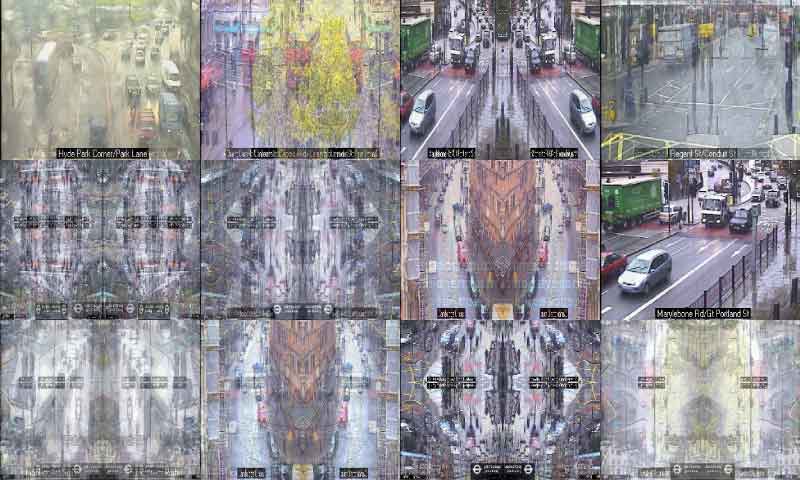
Artwork made in daytime London 11. 11. 2004. Digital Print 100 - 70 cm signed by Stanza
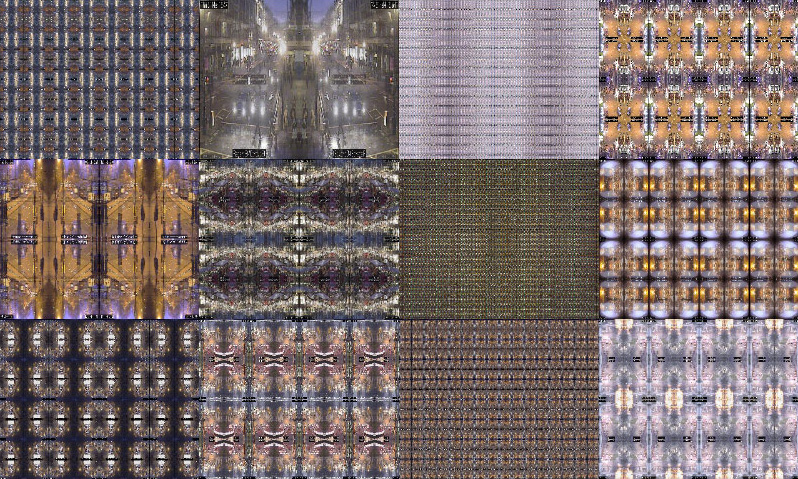
Artwork made London nightime 31. 3. 2004. Digital Print 100 - 70 cm signed by Stanza
The text below was commissioned for the Net Reality show and is written by Jo-Anne Green from Turbulence.org
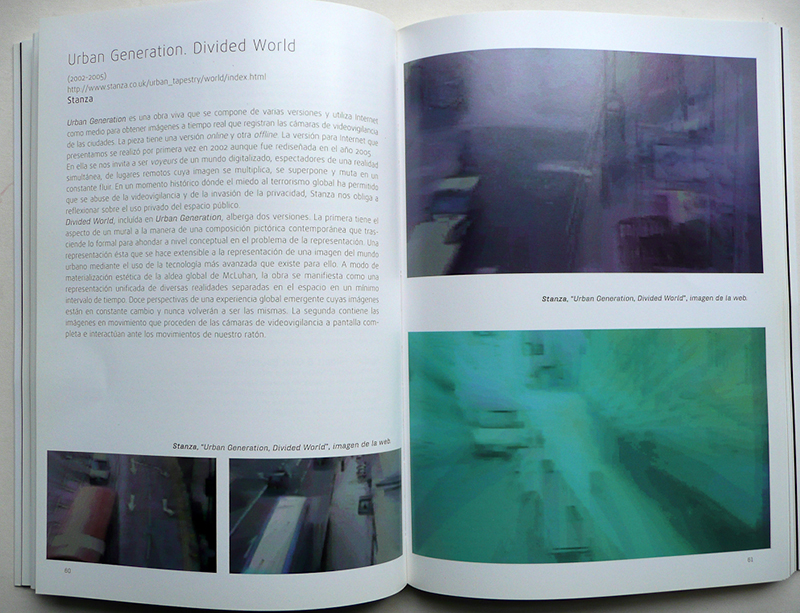
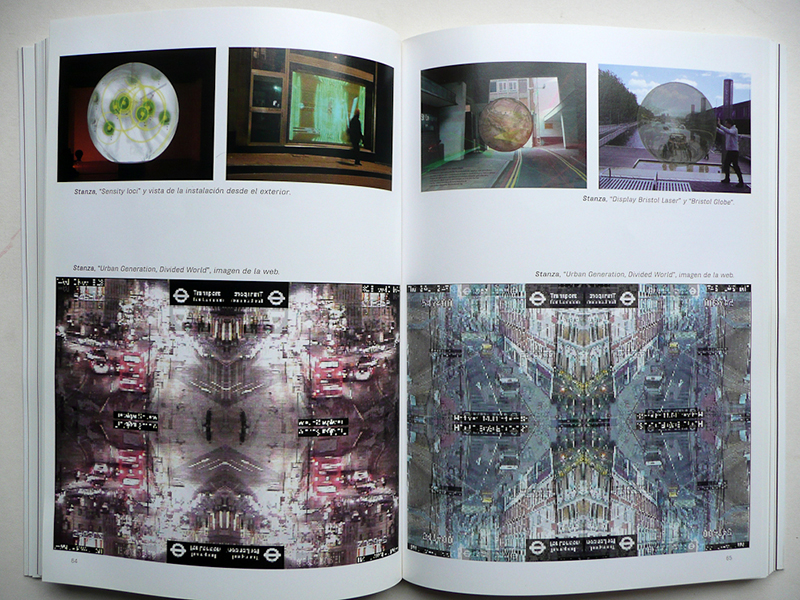
The “net” version of Stanza’s Urban Generation is visually rich and noticeably silent. As twelve live data streams alternately stutter in and out of existence and flow into abstract patterns and textures, the “live” scenes captured in real-time on CCTVs scattered throughout London quickly morph into kaleidoscopic Rorschachs that alter our initial perceptions and demand analysis. A generative work, it calls into question the “urban generation,” a period during which the threat of terrorism has made our environment ripe for surveillance and privacy abuse. Private space has become public space, public space has evolved into covertly “governed” or overtly corporate space.
While Stanza is well known for his interactive/participatory art, the “viewer” is forced to passively observe this piece, which simultaneously serves as a call to action.
According to the Associated Press [http://www.msnbc.msn.com/id/8501576/; July 7, 2005] “[a]n estimated 4.2 million cameras — largely concentrated in London and other major cities —observe Britons as they go about their daily business, [and] it is widely estimated that the average Briton is caught on various cameras up to 300 times on a normal day.”
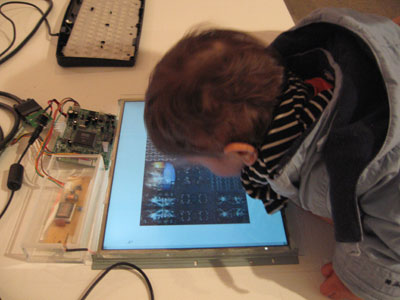
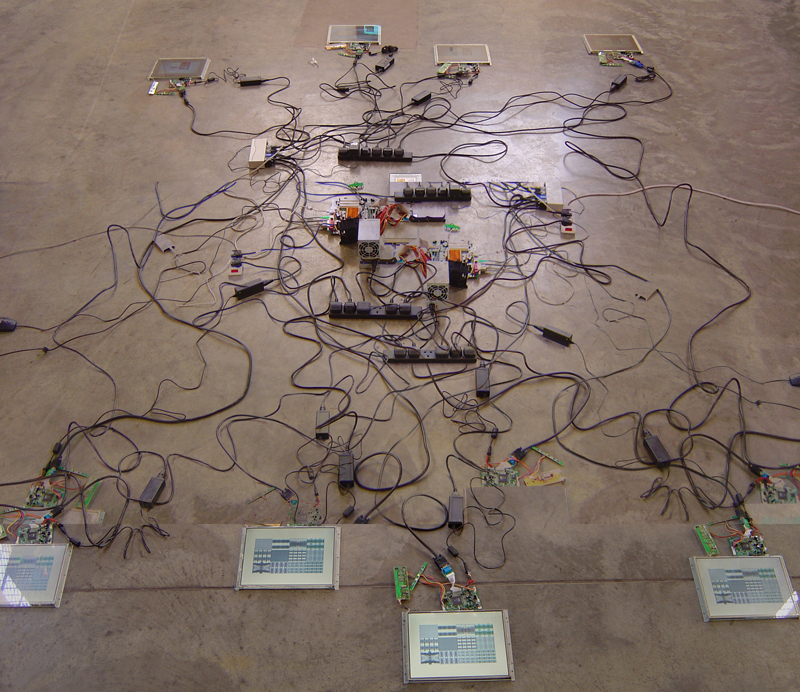
In the “reality” version of Urban Generation, the innards of a Dell computer, including an inoperable mouse and keyboard (rendering us powerless), are scattered across the surface of a large pedestal above which the gallery visitor must peer down, equating the “seer” with the elevated location of the majority of CCTV cameras. There are eight 15” LCDs, all of which display the “net” section of Urban Generation. Real and virtual, tangible and immaterial, fixed and constantly changing, the mass of wires, switches, circuit boards and LCD screens invokes the notion of the network exposed, turned inside out, laid bare for all to examine.
Urban Generation combines interior and exterior, and makes visible that which invisibly and silently tracks our movements, habits, and preferences. It forces us to ask ourselves whether pervasive surveillance is inevitable, and whether it is sufficient to allow these billions of hours of stored data to serve as evidence after the fact rather than prevention.
Technology and installation details.
The work ideally needs a plynth the size should be 2.45m by 3m by 35 cm. If no plinth its goes on the floor.
The size of the shipping crate is. 54 cm by 66cm by 66 cm exact; weight approx 30 kg, contents fragile.
Set up time approx four hours plus some assistance at the venue to set up the internet configuration.
The work should be insured at the venue and during transit.
|
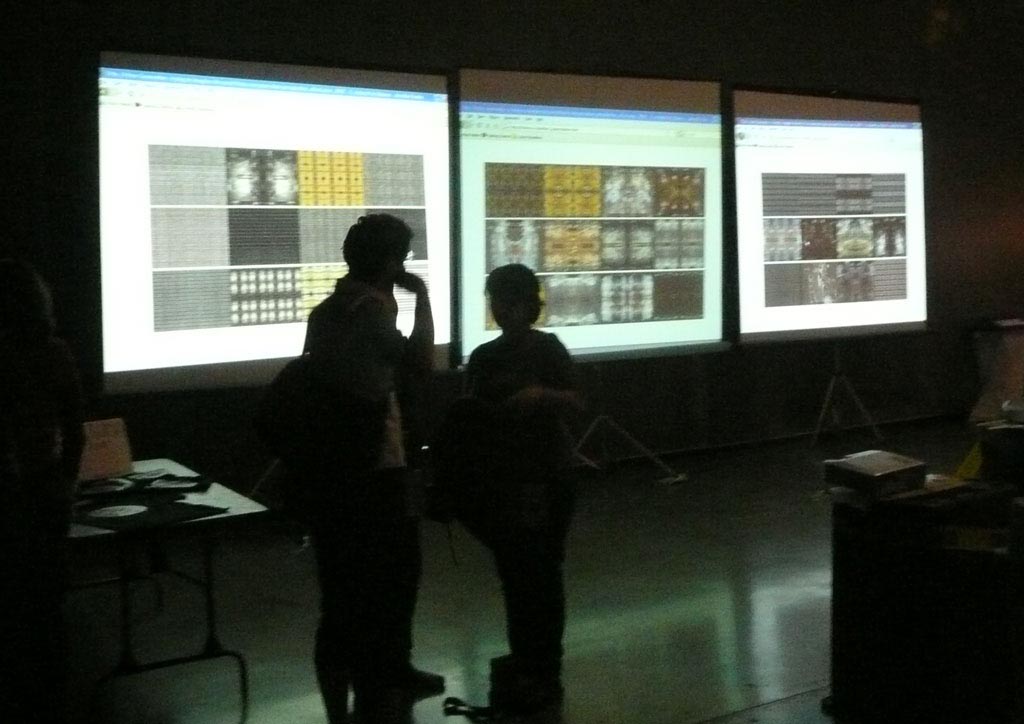
Live at SXSW 2009 Austin Texas. Set up as installation using three projectors. Needs live internet connection and three computers.
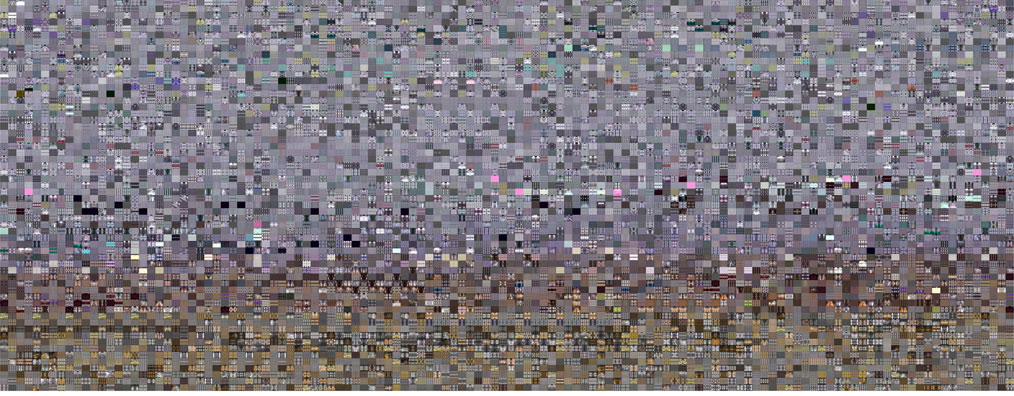
A Day In The Life Of The Urban Generation. 3 metres by 1.6 digital print. Signed By Stanza
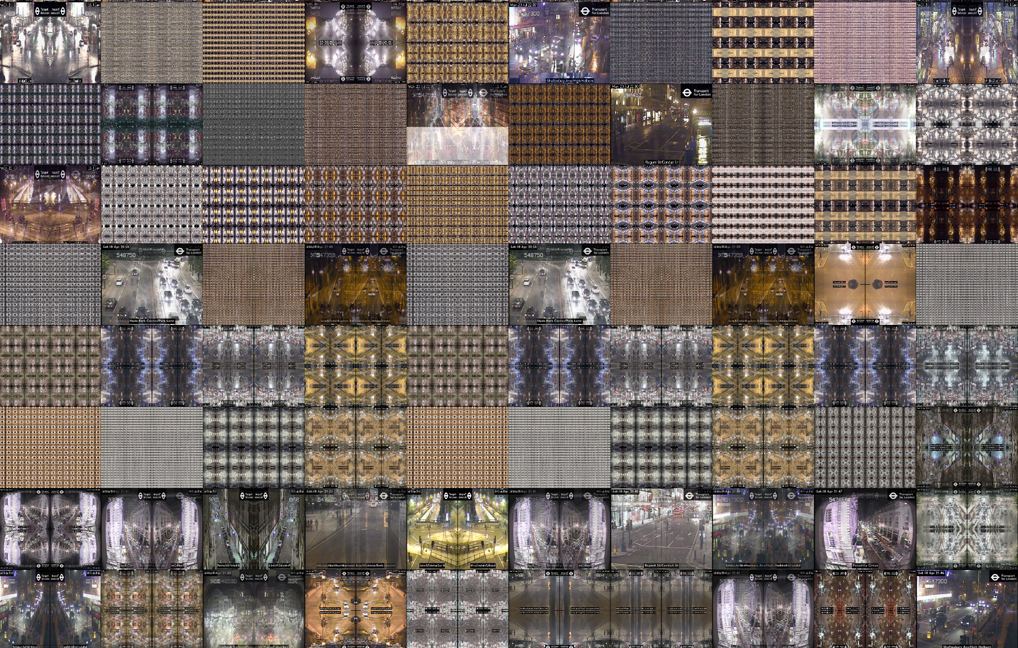
Title - "A Day In The Life Of The Urban Generation". 300cm by 160cm digital print. (detail of above)
"A Day In The Life Of The Urban Generation". (download detail for print of above for catalogues)
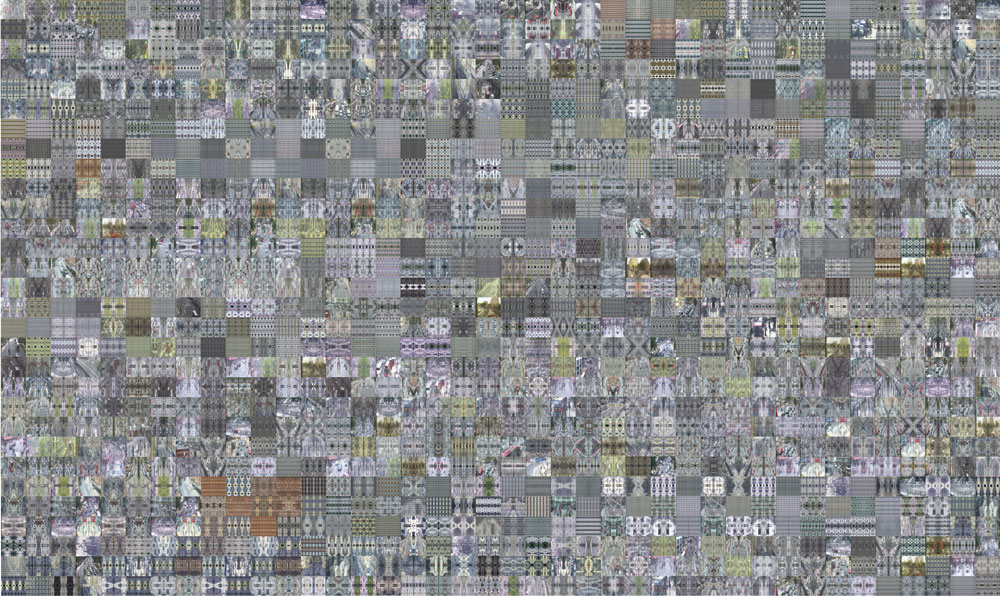
"Regeneration Generation" 251cm by 118 cm
Original artwork made using artists software system taking images from 200 CCTV cameras in one day in London.
Signed By Stanza
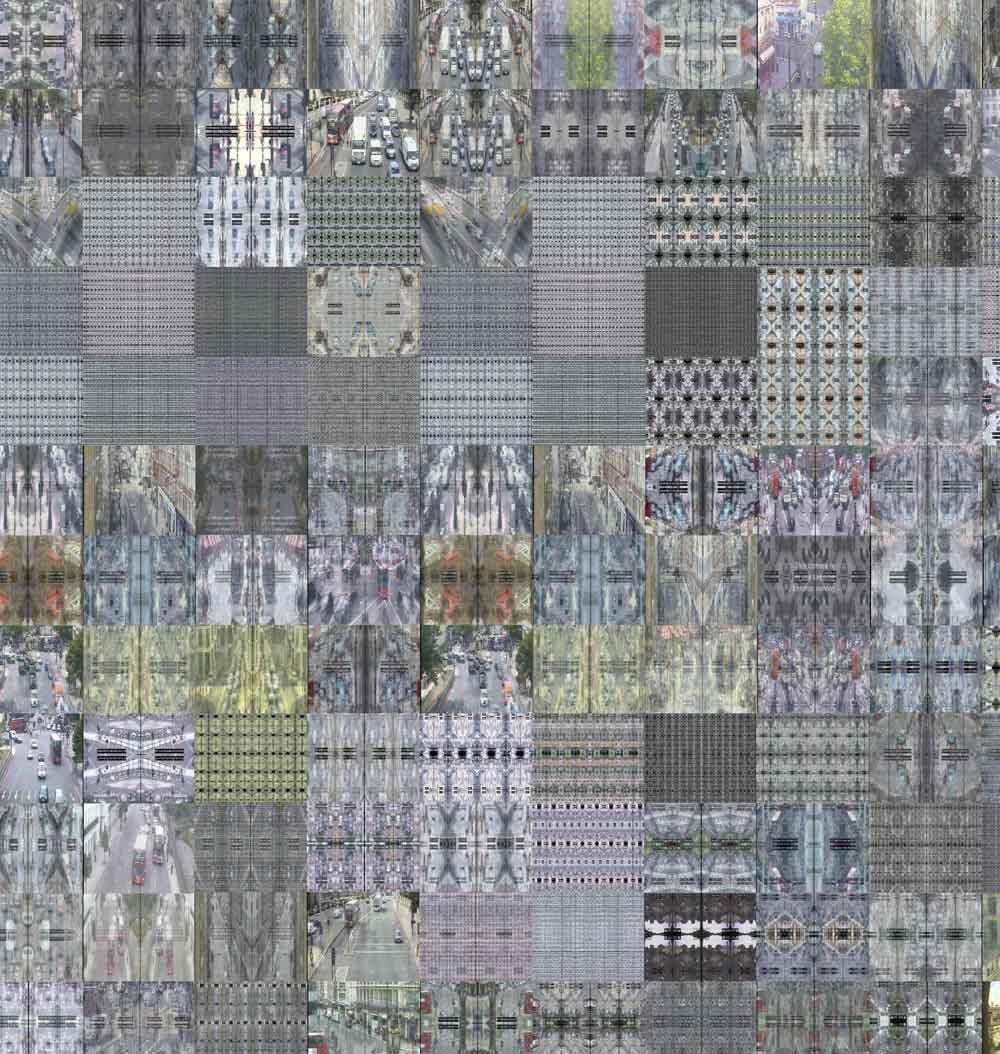
Detail "Regeneration Generation" original artwork taken from the artists software system made of images from CCTV cameras taken in 1 day in London. 120 cm by 90cm .
From and essay "Philosophical Issues in the Art of Stanza" by Graham Harman
The London-based artist Stanza has been exhibiting for over three decades, and has been drawn consistently to themes of surveillance technologies, as in the “panopticon” addressed by Michel Foucault but later treated more skeptically by Bruno Latour and Emilie Hermant. The theme of surveillance has been a central concern in the social sciences in recent decades. Much of the credit for this obviously must go to Foucault, due to his well- known passages in Discipline and Punish on Jeremy Bentham’s “Panopticon,” an institution whose inhabitants (prisoners, students, patients, or otherwise) might be watched at any moment from a central observation point. As Foucault puts it: “The Panopticon is a marvelous machine which, whatever use one may wish to put it to, produces homogeneous effects of power.”
Urban Generation; trying to imagine the world from everyone else’s perspective, all at once
(2002)
There is an apparently deliberate tension between the description of the work and its title. On the one hand, the title seems to celebrate the diversity of perspectives housed in the minds of contemporary urban youth, and thus strikes an optimistic and progressive note. On the other, the accompanying description invokes the rather Foucauldian phrase “universal surveillance” and reminds us of today’s security-obsessed London, which is practically depopulated of unwitnessed events. Though to some extent this ambiguity remains even after we have seen the work for ourselves. The images multiply so numerously that not even a team of Stasi officials could discern whatever subversive deeds might be hidden in these frames. Indeed, the video transmits so much information that it dies as information only to be reborn as sheer kaleidoscopic spectacle, in the sort of reversal that Marshall McLuhan studied so intensively.
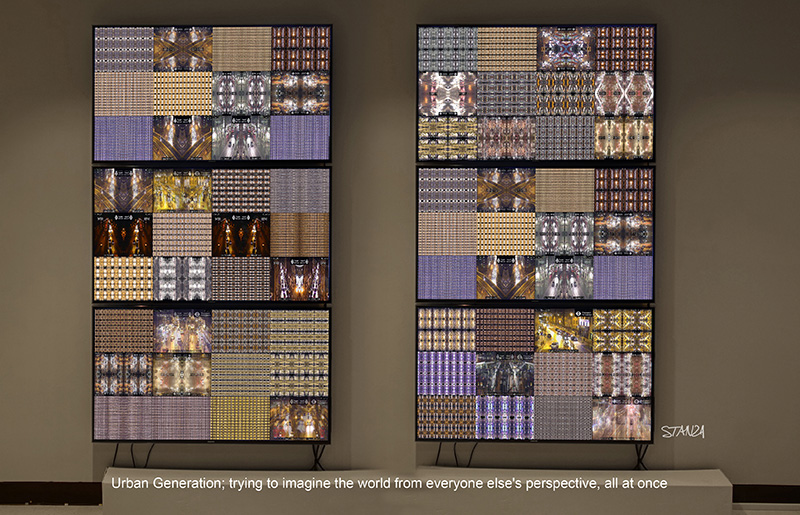
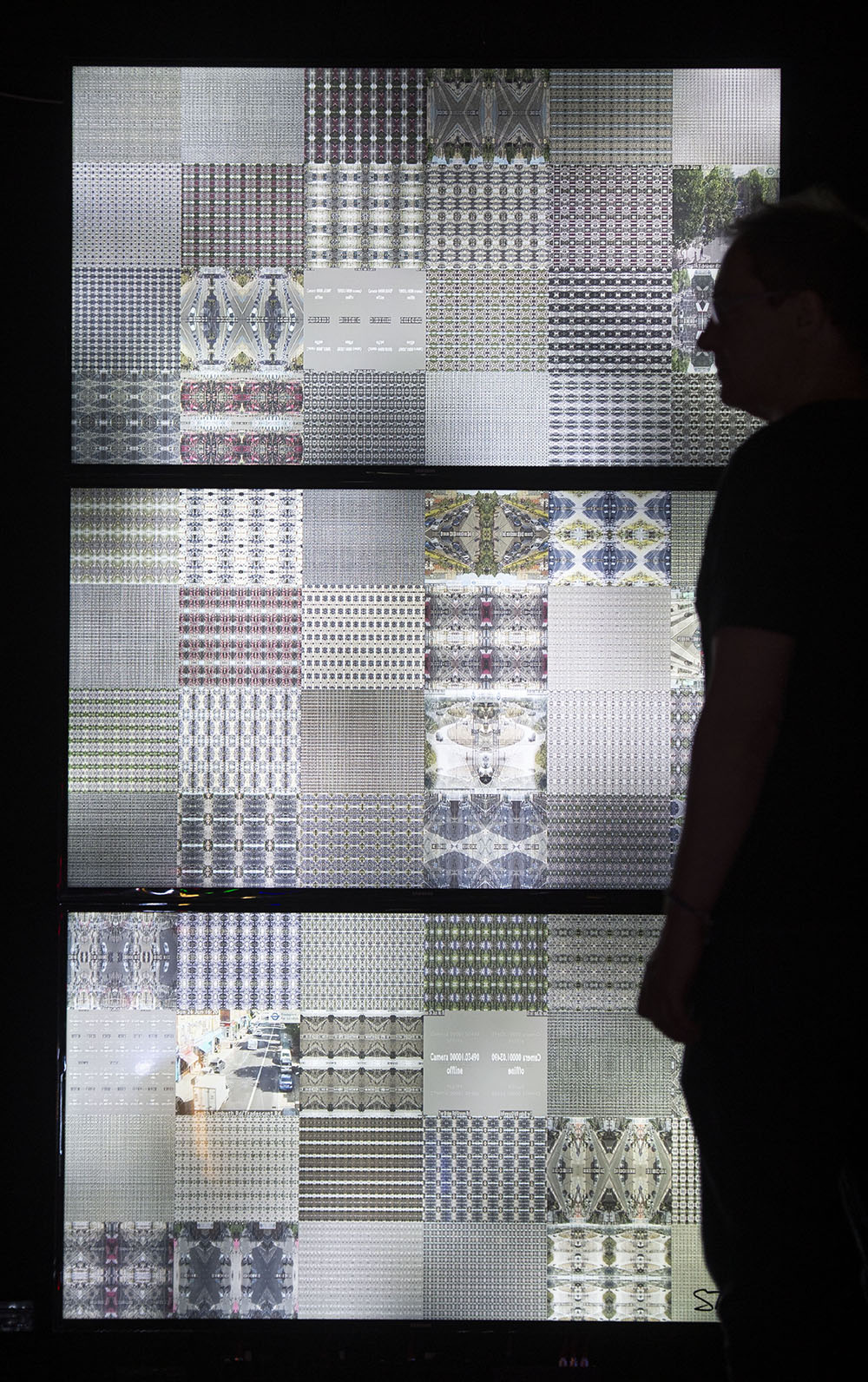
Dr Stanza: This artwork demonstrates how we are complicit and thus entangled in the surveyed and monitored technological layers, fitting seamlessly into what he calls panoptic aesthetics.
All images and artwork © Stanza (Steve Tanza) 2002. All rights reserved.


++++++++++++++++++++++++++++++++++++++
Urban Generation: Trying To Imagine The World From Everyone Else's Perspective, All At Once
Version 3 1920-1080
Version 4 1024-768
Version 4 1920-1080 (Use pale moon broswer with shockwave and it still works)
|