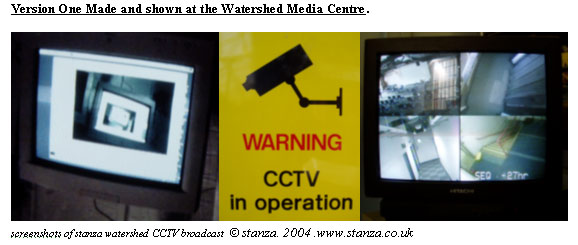
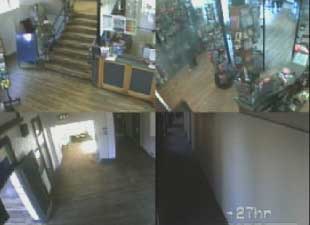
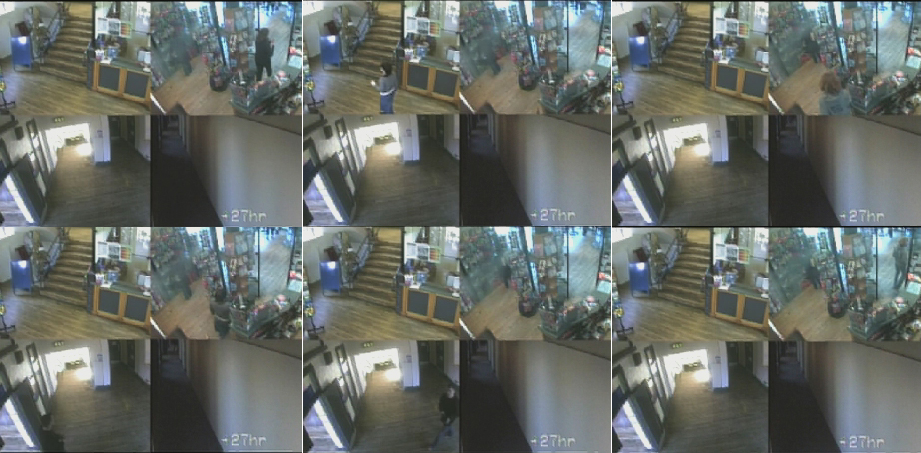
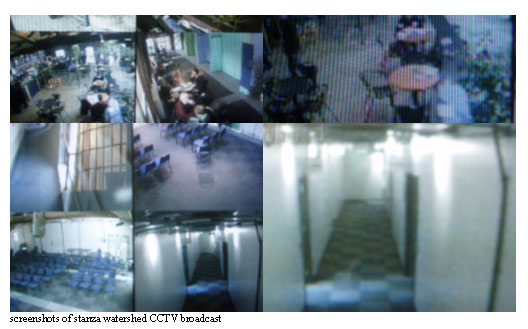
In the first version an experimental relay was adapted from the Watersheds CCTV live footage of the general public entering the Watershed gallery. A live internet broadcast on 26.2.2004. This used multiple CCTV cameras output through a composite BNC, and then through an analogue to digital converter. (could be a effects box for future use). The DV out is then input to Quicktime Broadcaster the free software version and out put and served up through Sorenson to the apple quicktime streaming server and unicast over the internet.
An interface software suite allows the images to be mixed a sort of CCTV ming kit.
http://rtsp.watershed.co.uk/live/stanza.sdp
(no longer online in real time but documentation is available below)
Future Development.
To build a touch screen kiosk that controls all the feeds from the cctv and is available for the public to 'play' and create new narratives. The screen will have new filters and using custom software it will allow a whole series of perspectives on the people and the space. This way the users control the images that are displayed either on the building or in the street.
Software.
The software will be customised and built to meet both the specification of the units that are already deployed in a building or more will be brought in to enhance the system and give camera intelligence. The images off the streams are then manipulated. These data streams are distributed to a system where they are processed before being rendered to a screen.
The outcomes are affecting experiences with effected manipulation. With additional modification and the whole system can also be web based to allow real time broadcasting of the results. (as was the first original test to a quicktime streaming server). The opening up of data and information to the public domain is an important part of the work.
Hardware
I have been talking to CCTV systems engineers and other programmers. I am interested in working with an organisation that might utilise either the buildings intelligent data that may be in place such as cctv as well as the cameras in the touch screens.
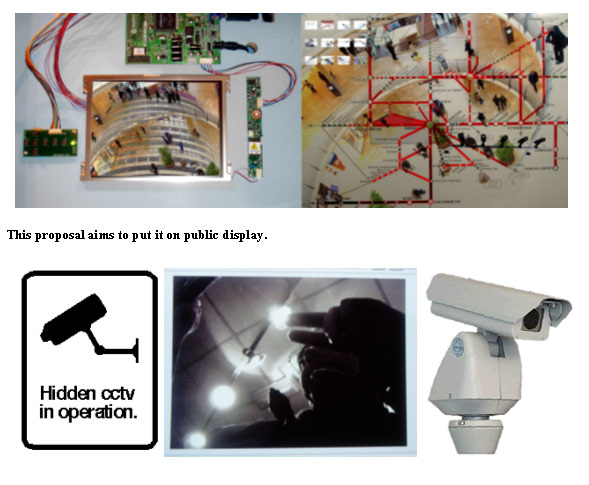
Version One: Made and shown at the Watershed Media Centre. This version also broadcast the results onto the internet. ie live cctv online for all to see
.
Performance Mode
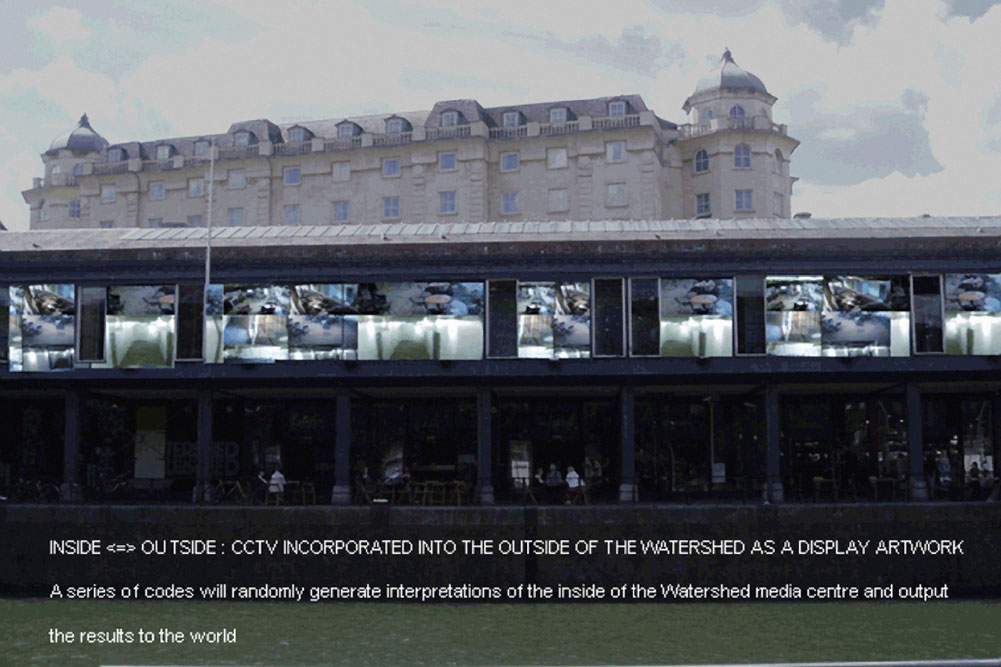
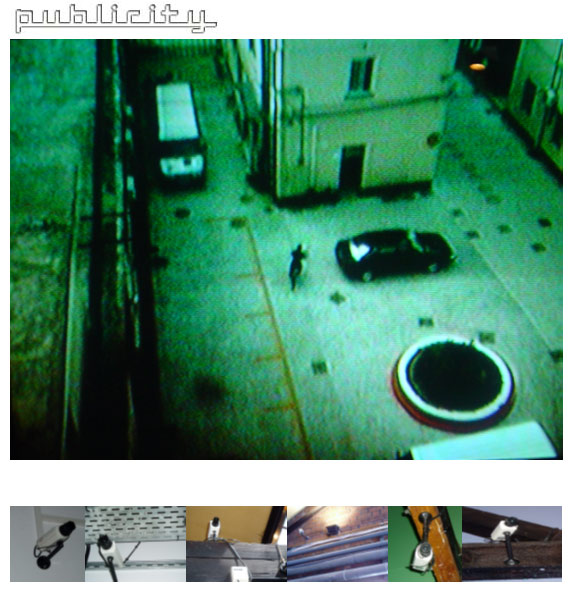
Surveillance suite CCTV system. I have devised a 'Publicity' performance using and mixing the data in the living space as a performance. All the resulting data is projected over the building so that the outside of the building becomes a huge display network. In essence the outside of the building represents the inside of the building. The space and the physical body is represented as a huge display. The cctv images and the protected data is externalised and made public. There is nothing to hide. Everything is made transparent.
Output.
- through online environment for monitoring of cameras for open access
- back into urban spaces as installations controlled via touch screen
- projected into fabric as real time film of the internalised space.
- re made into a real building whose whole architecture is the data from the inside of the internalised space.
- representation of flow in building and space.
LEGAL ISSUES FOR CCTV
There are a whole series of legal issues surrounding the use and misuse of CCTV. CCTV data is protected by the data protection act and these acts vary from country to country and across borders. You have rights to view these images although the copyright image owners will not be yours even if you are the subject.
Anyone recorded on cctv also has he right to request a copy of the cctv footage.
In terms of my project, this is the legal advice from a lawyer I was given:
It seems there are two choices
1. Approach the Information Commissioner for guidance which is likely to take some time but will be definitive.
2. Ensure that the use of the CCTV system is likely to be outside the scope of the Data Protection Act 1998 or will be exempt from under the Act.
Basically the conditions one would need to follow, to broadcast the CCTV footage (via web, pdas etc), for your projects are:
- The use of fixed specified cameras that are not focused on individuals (although you will note many organizations do this, but they don't broadcast the information)
- Ensure to make individuals non-recognisable (ie. Through some manipulation/blurring of the image).
- Provide signage and information so that the public are aware of the project and its intended use.
- The footage would be used for a creative project only and this makes you exempt from the data protection act.
Funding.
Although version one prototype was made and finished in 2004 this project still needs funding to take it to the next stage both financial and also collaborative support FOR THE DEVELOPMENT OF THE TECHNOLOGY, and to find venues who are interested in doing this.
Venues where this would be good include the new extension to Tate Modern, Colleges, Hospitals.
This project requires further funding for specialised installation set up using multiple projectors and specialised display technology.
In order to re -represent real time cctv footage online and in an installation space a whole series of technical issues need to be overcome , the fundamental one being how to deal with such a large multiple frame rate over the net. I have already made a number of solutions, and work arounds.
However I am seeking consultation in order to move this technically to the next level. I need access to other cctv networks, to broadband network technicians, and to camera makers and consultants.
Initial research AND prototype development was supported by Nesta and the Clarks Bursary 2004.
Other related stanza works using CCTV.
SOUL uses cctv to make large scale outdoor events.....http://www.stanza.co.uk/ideasrus/soul/index.html
Live Data on the roof of the Watershed .........http://www.stanza.co.uk/ideasrus/display/index.htm
Online 3d sculpure using live CCTV..............http://www.stanza.co.uk/micro_city/index.html
Urban Generation real installation in gallery using CCTV .......http://www.stanza.co.uk/urban_tapestry/index.html
Spying on crowds in NYC ........http://www.stanza.co.uk/i_spy/index.htm
All images, text and artwork (c) STANZA 2003 - 4
www.stanza.co.uk

email: stanza@sublime.net